Lead Hazard in Crayons
research from ‘Art Hazards News’
Recalls of Imported Crayons Because of Lead Poisoning Hazard
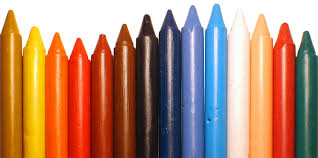
colored crayons (Wikipedia)
UPDATE, 2025: : kids and artist’s crayons frequently have been found to contain unacceptable levels of lead / since the Pandemic overall the average toxicity of art materials has increased, so this is likely to remain a major problem today.
Crayons imported from China by the following companies:
Crayons imported from China by the following companies:
“12 Jumbo Crayons”, Concord Enterprises, Los Angeles, CA
“Safe 48 Non-Toxic I’m a Toys “R” Us Kid! Crayons,” Toys “R” Us, Paramus, NJ
“12 Crayons, Glory” and “18 Crayons That Paint, Conforms ASTM D-4236,” Glory Stationary Manufacturing Company
Limited, Los Angeles, CA.
“64 Crayons, School Quality, No. 8064, ” A.J. Cohen Distributors, Hauppauge, NY.
“64 Crayons, #CR 64-64 CT,” Baum Imports, New York, NY.
“12 Super Jumbo Crayons,” Dynamic Division of Agora International, St. Albans, NY.
“8 Crayons, No 5 CL 850,” Dynamic Division of Agora International, St. Albans, NY.
“Fun Time 72 Crayons, No. B541,” Overseas United, New York, NY.
“64 Crayons, Kidz Biz,” Bargin Wholesale, Los Angeles, CA.
“64 Crayons, SKU#51-02600,” Universal International, Minneapolis, MN.
“Feido, 12 Crayons, No. CC8812,” Kipp Brothers Inc., Indianapolis, IN.
The Problem
All of these crayons contain lead. The first three (Concord, Toys “R” Us, and Glory) contain enough lead to present a lead poisoning hazard to young children who might eat or chew on the crayons. While sources such as lead paint are major causes of lead poisoning, it is important to eliminate other contributors to lead poisoning, such as these crayons.
The other eight brands do not contain enough lead to increase the blood lead level above the threshold level for lead poisoning, assuming a typical scenario of a child chewing on small pieces of lead-containing crayons over a span of time. However, CPSC is very concerned about these crayons because they add to the overall “lead load” to children who may eat them. If a child ate an entire lead-containing crayon over the same span of time, the lead poisoning threshold for these crayons would be exceeded.
What To Do ?
Take the crayons away from children and discard them or, for most of the brands, take them back to the store for a refund. The crayons sold by Bargin Wholesale and by Universal International are being recalled from the importers’ retail chains. Only buy crayons and other children’s art materials that have this label: “Conforms to ASTM D-4236” (or similar wording), which means that a toxicologist has reviewed the formula of the art material for chronic hazards.
For More Information
For the complete CPSC press release, telephone the Commission’s toll-free hotline at 1-800-638-2772, or write the
CPSC at: Office of Information and Public Affairs, 4330 East-West Highway, Bethesda, MD 20814.
Art Hazard News, Volume 17, No. 2, 1994
This article was originally printed for Art Hazard News, © copyright Center for Safety in the Arts 1994. It appears on
nontoxicprint courtesy of the Health in the Arts Program, University of Illinois at Chicago, who have curated a collection
of these articles from their archive which are still relevant to artists
More Problems with Crayons
In cooperation with the Consumer Product Safety Commission (CPSC), Shure Products Inc. from Chicago IL, is voluntarily recalling about 14,000 “Kaleidoscope Art” sets (item number 820).
Although the product box is labelled “non-toxic” and “conforms to ASTM D-4236” these crayons contain enough lead to present a lead poisoning risk to young children, who might eat or chew on the crayons. Shure Products and Toys-R-Us, the retailer for these sets, initiated the recall after CPSC laboratory analyses showed that Kaleidoscope Art set crayons had high levels of lead.
The Kaleidoscope Art sets, which Shure imported from China, were sold nationwide by Toys-R-Us from January through August 1994. Each Kaleidoscope Art set contains a box of eight crayons, six sheets of “line art” (geometric shapes to color), and a six-inch kaleidoscope. The set is labeled “Ages 4 & up.” Consumers who own these sets should take them away from children immediately and return them to Toys-R-Us for a refund.
It was the New York State Consumer Protection Board who alerted the CPSC to this problem. According to Shure, they had the products tested in the appropriate manner at a private testing laboratory. While the CPSC and Shure Products Inc. have not received any reports of injuries or illnesses involving Kaleidoscope Art sets, the commission and the company are conducting this recall to prevent the possibility of injury or illness.
For more information about this recall, consumers may call Shure Products Inc. at (773) 227-1001, or contact the CPSC Consumer Hotline at (800) 638-2772.
Art Hazard News, Volume 17, No. 4, 1994